
The restoration question
The churches of Christ emerged from a movement determined to move beyond denominational divisions and recover the Christianity of the New Testament. That instinct raises an important historical question: if we want the faith and practice of the apostles, what do the Christians immediately after the apostles tell us about what that faith looked like?
Are we looking for our version of a Bible-based church, or the Church the Bible is based on?
Does your church teach what Scripture itself says, that the Church is “the pillar and foundation of truth”? (1 Timothy 3:15)
Does your church teach that Jesus established a visible Kingdom and gave real authority within it? (Matthew 16:18–19)
Does your church teach that Christ gave His ministers authority to forgive sins? (John 20:21–23)
Does your church practice the biblical rite of calling the ministers of the Church to anoint the sick with oil, with the promise that sins will be forgiven? (James 5:14–15)
Can your church trace its historical continuity back through the Christians who came directly after the apostles, all the way to the apostles themselves?
Does your church teach that the Church has authority to bind and loose, with those decisions ratified in heaven? (Matthew 18:18)
Does your church have the authority to hold councils to confront heresy, address issues of faith and morals, and faithfully declare, “It seemed good to the Holy Spirit and to us”? (Acts 15:28)
Does your church honor celibacy for the sake of the Kingdom? (Matthew 19:12; 1 Corinthians 7:32–35)
Does your church teach that good works and obedience are an essential part of the Christian life and final judgment? (Matthew 25:31–46; James 2:26; Matthew 7:21; Romans 2:6)
Where Did the Idea of Restoration Come From?
Before I could believe that Christianity needed to be restored, I realized that I first needed to find out whether it had actually been lost.
Richard Tristano describes the basic historical premise behind the Restoration Movement in The Origins of the Restoration Movement: An Intellectual History:
“the Restoration Movement depended on a notion of a golden age — New Testament Christianity — a restoration of the beliefs and practices of that age, and a "dark age" in between.”
That raises the question I eventually had to confront: Does history actually show Christ's Church disappearing into apostasy for centuries and eventually needing to be restored? Or does history show a visible Church that never disappeared at all?
There was another question I had never seriously considered:
Is Scripture really my highest authority, or is my own personal interpretation of Scripture my highest authority?
If I say, “I only believe what the Bible teaches,” what I may actually mean is: “I only believe what I believe the Bible teaches.” Those aren't necessarily the same thing.
Richard Tristano's complete book is available for free online through Abilene Christian University. Read the complete book.
The Internet Changed the Question
The reality is that the internet has completely changed access to information. And now A.I. has made it easier than ever to sift through enormous amounts of information and know where to start looking.
EVERYONE can read the earliest Christians. Everyone can study Church history. Everyone can look up the sources and VERIFY the claims for themselves.
And that creates a serious problem for the theological theory at the absolute CORE of the Restoration claim.
For most of its history, the churches of Christ have claimed to be the ONLY restored New Testament church. Not a denomination. Not merely another Protestant group. Not one branch of Christianity among many.
The claim was that by returning to Scripture, the original Church established by Christ had been recovered.
For generations, that claim carried enormous weight.
But now people are asking questions that previous generations rarely asked:
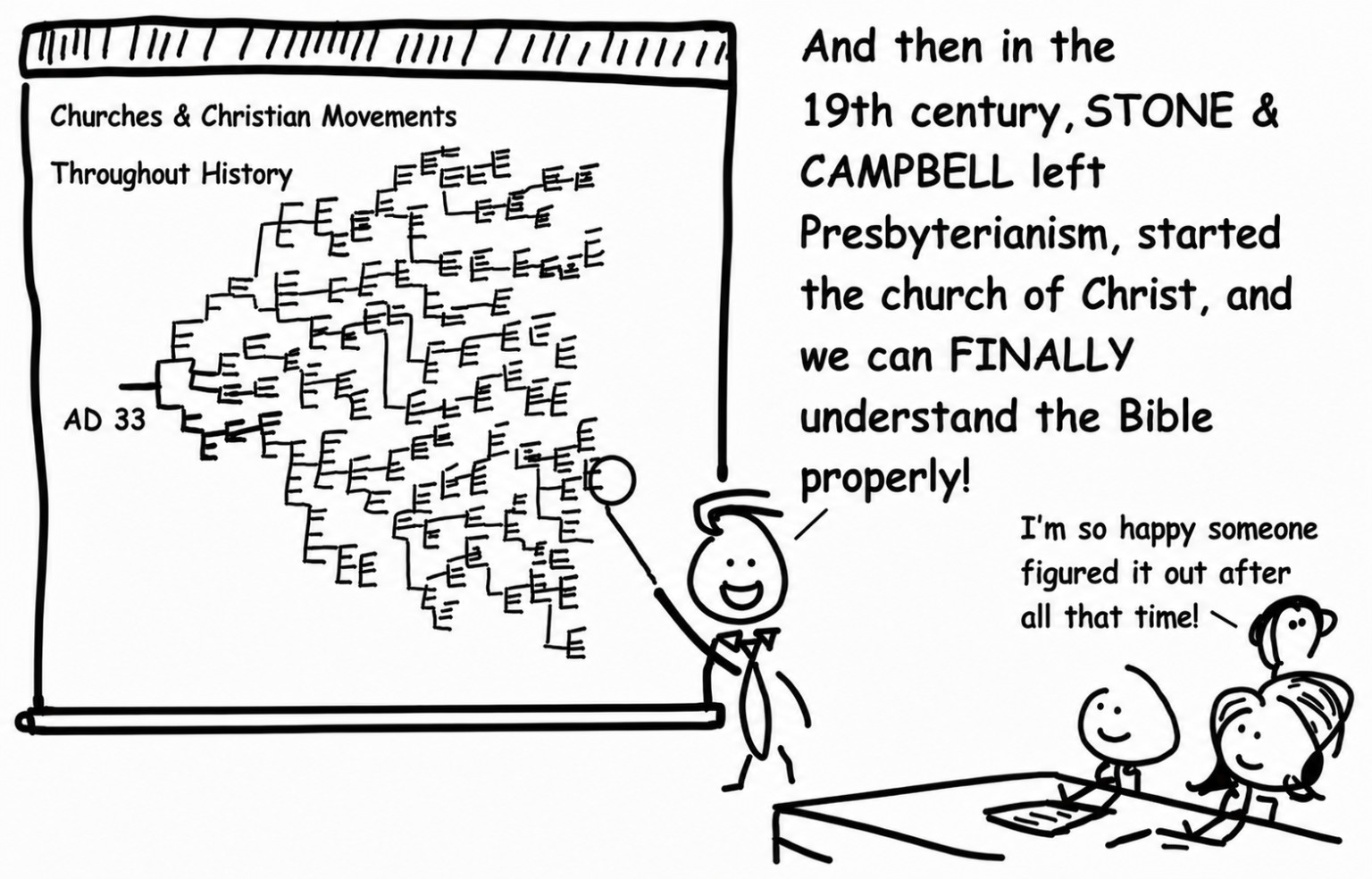
Where was the Church before the 19th century?
What happened between the apostles and Campbell?
If Christ established a Church in the first century, where was that Church throughout history?
And perhaps most importantly:
If Christ promised that His Church would endure forever, why would it need to be restored in the first place?
These are logical questions that Restorationism itself creates.
The Restoration Movement was built upon a challenge:
Let's return to the original Church.
But eventually someone is going to ask:
If we're restoring the original Church, what happened to the original Church?
And that's where the difficulty begins, because Scripture makes extraordinary promises about the Church.
Jesus says:
“I will build my church, and the gates of hell shall not prevail against it.”
Paul says:
“To him be glory in the church and in Christ Jesus throughout all generations, forever and ever. Amen.”
Daniel prophesies:
“In the days of these kings, the God of heaven will set up a kingdom which will never be destroyed, a kingdom that will not be left to another people.”
These passages describe something visible, enduring, and permanent.
A Church that survives.
A Kingdom that remains.
After all, no one lights a lamp and then hides it.
And yet the classic Restoration narrative seems to require the opposite conclusion.
A Church that Christ promised would endure, yet at some point can no longer be clearly identified as the Church He established.
A Church whose original faith and structure must eventually be recovered.
A Church that, after more than seventeen centuries, needs to be restored in America.
That's the tension I could no longer ignore.
And because information that once required access to specialized libraries and obscure books is now available to almost anyone with a phone, I believe the churches of Christ are entering a period unlike anything they have experienced before.
The question is no longer whether we can investigate what happened to the original Church.
We can.
The question is whether we're willing to follow the evidence wherever it leads.
“The church of the first century became the Catholic Church of later centuries...”
If the church of the FIRST century was the Catholic Church, that means that it's the one and only Church that Christ established. At no point could it STOP being the Church that Christ established. That doesn't make any sense! Didn't Christ say that His Church would ALWAYS be guided by the Holy Spirit? (Jn. 14:16,17) And how does this square with Timothy saying that the Church (not the Bible) is the pillar and foundation of truth? (1 Tim. 3:15)
Watch
These videos provide several starting points for examining the Church of Christ tradition, the Restoration Movement, and the question of Christian continuity.
Church of Christ & the Restoration Movement
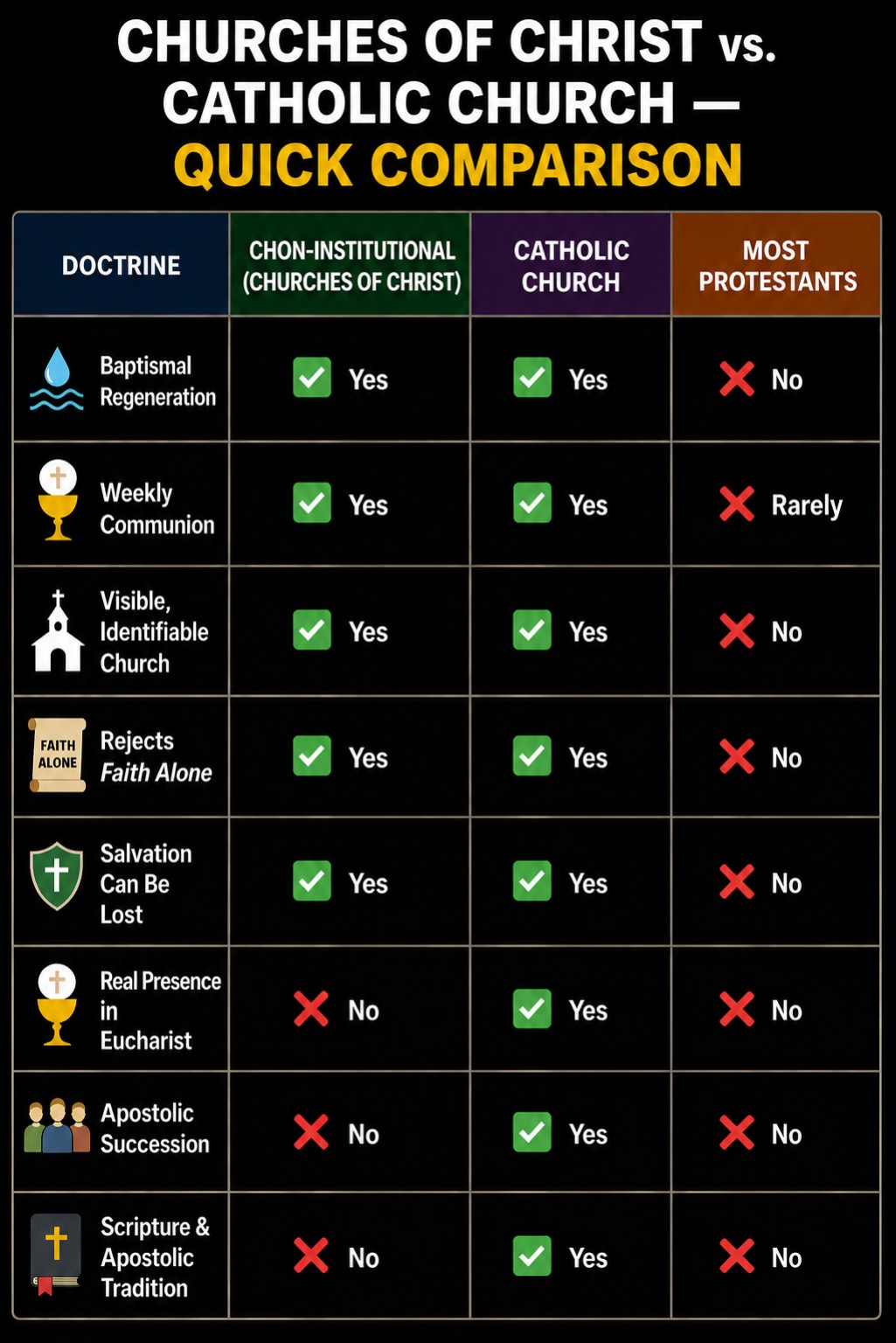
Chairs (COC)
Church of Christ Roundtable — The Journey Home
Maybe there's another way?
Watch
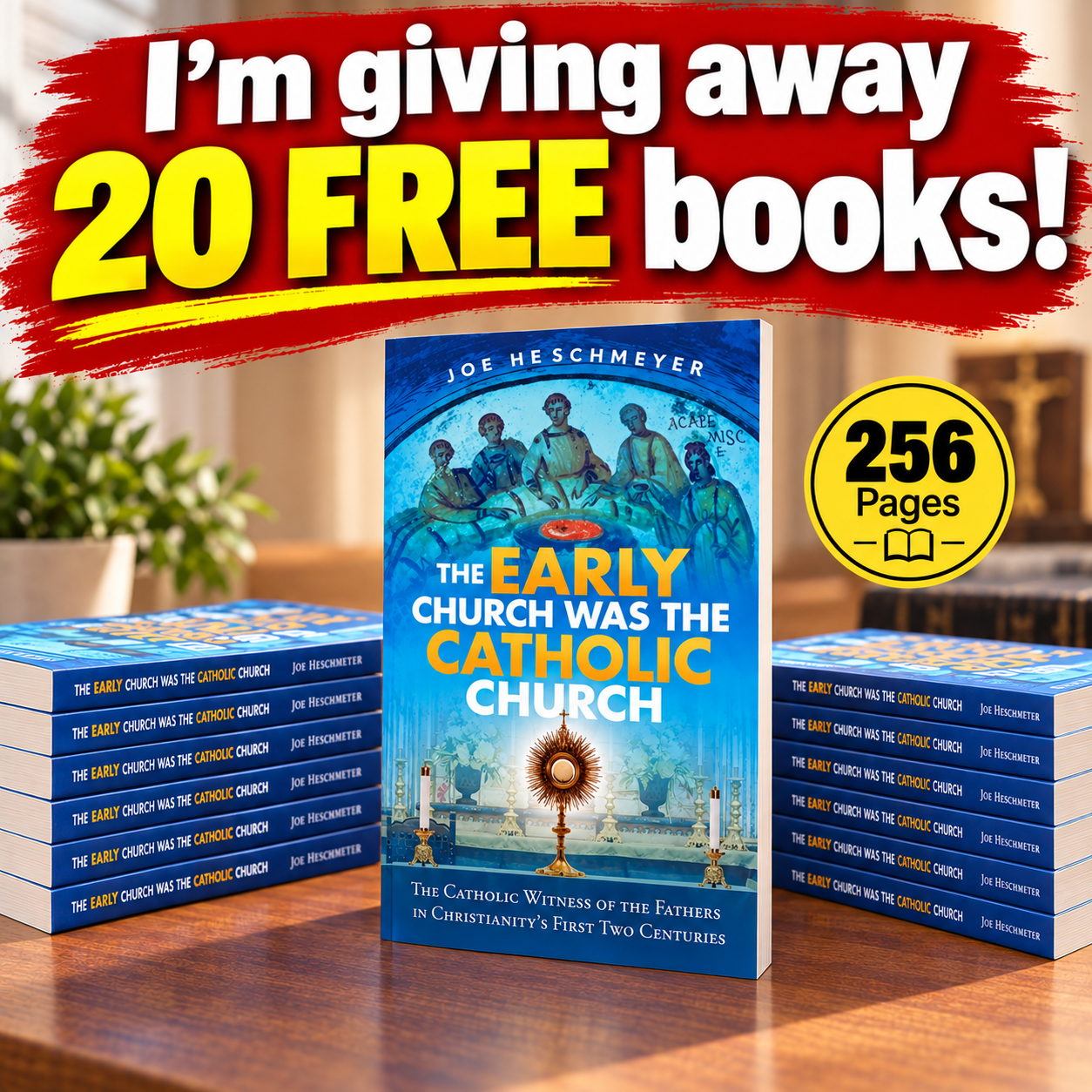
If you’re sincerely interested in what the Christians closest to the apostles actually believed, I want to help you investigate it for yourself.
I’m giving away 20 FREE copies of Joe Heschmeyer’s The Early Church Was the Catholic Church.
No strings attached. I simply want you to read the evidence and decide for yourself.